More than 1/3 of women experience diastasis recti or abdominal muscle separation after childbirth. The rectus abdominis is a superficial abdominal muscle that covers the deep stabilisers of the trunk and provides the function of spinal flexion. Rectus diastasis is a condition of spacing of the abdominal wall in the area of the connective tissue of the linea alba, which often stretches laterally and thins after pregnancy.
Rectus diastasis causes a loss of tension in the connective tissue of the abdominal wall and increases the risk of lumbar pain or low back pain if it becomes chronic. Rectus diastasis is a normal physiological phenomenon in pregnancy up to two fingers wide.
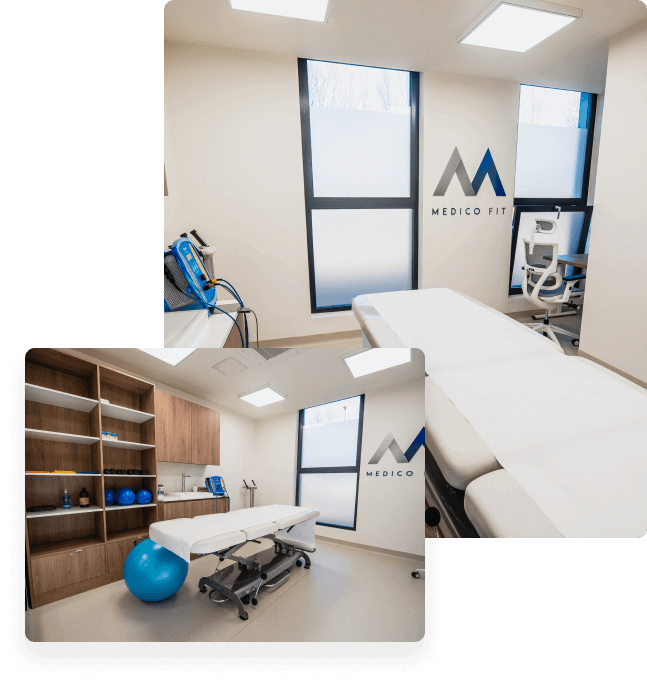
At the Medicofit clinic, we treat rectus diastasis in the context of special physiotherapy for women and physiotherapy for pregnant women. Special exercises during pregnancy should not be too intense, but women should maintain good activation of the deep abdominal wall due to the increased stress on the spine and preparation for childbirth. Abdominal wall spacing usually occurs after 16 weeks of pregnancy and persists up to 24 weeks post-pregnancy, and in certain women it can become a chronic abdominal wall condition.
Rectus diastasis is characterised by the inability to contain intra-abdominal pressure, which is noticed by the woman as a bulge in the middle of the abdominal wall when leaning backwards. Rectus diastasis increases the risk of low back pain, poor posture, urinary incontinence and pelvic organ prolapse.
Rectus diastasis is an expected adaptation of the connective tissue of the abdominal wall in pregnancy, so it is important that a pregnant woman is assessed for rectus diastasis only after the 3rd week of pregnancy. Women should know that the width of the diastasis is not a risk factor in the case of strong connective tissue, but the depth of the rectus diastasis, assessed by a specialist physiotherapist, is the key to normal abdominal muscle function. In case of deep diastasis, emergency physiotherapy is indicated for the woman.
Rectus diastasis is more common in second births and in women over 35 years of age, and can also occur as a result of genetic factors, e.g. congenital increased laxity (stretchability) of the connective tissue, incorrect abdominal wall exercises, weak core muscles, incorrect lifting of loads, multiple pregnancies.
Make an appointment for diastasis recti
In pregnancy, the hormone relaxin plays an important role in the relaxation of connective tissue and is indirectly responsible for the expansion of the linea alba.
The key for women with suspected rectal diastasis is to undergo a diagnostic examination, which at the Medicofit clinic is carried out at the earliest 4 weeks after pregnancy. If abdominal wall dysfunction and deep diastasis are detected, we start with special exercises, which must be graded appropriately otherwise they pose a risk of umbilical and inguinal hernia.
Physiotherapy for rectus diastasis also includes correct ”bracing” of the deep abdominal muscles and increasing the isometric strength of the abdominal wall. Physiotherapy for rectus diastasis is usually carried out in a 10-week programme of special physiotherapy, where the correct steps in loading the abdominal wall with exercises are essential.